Introduction
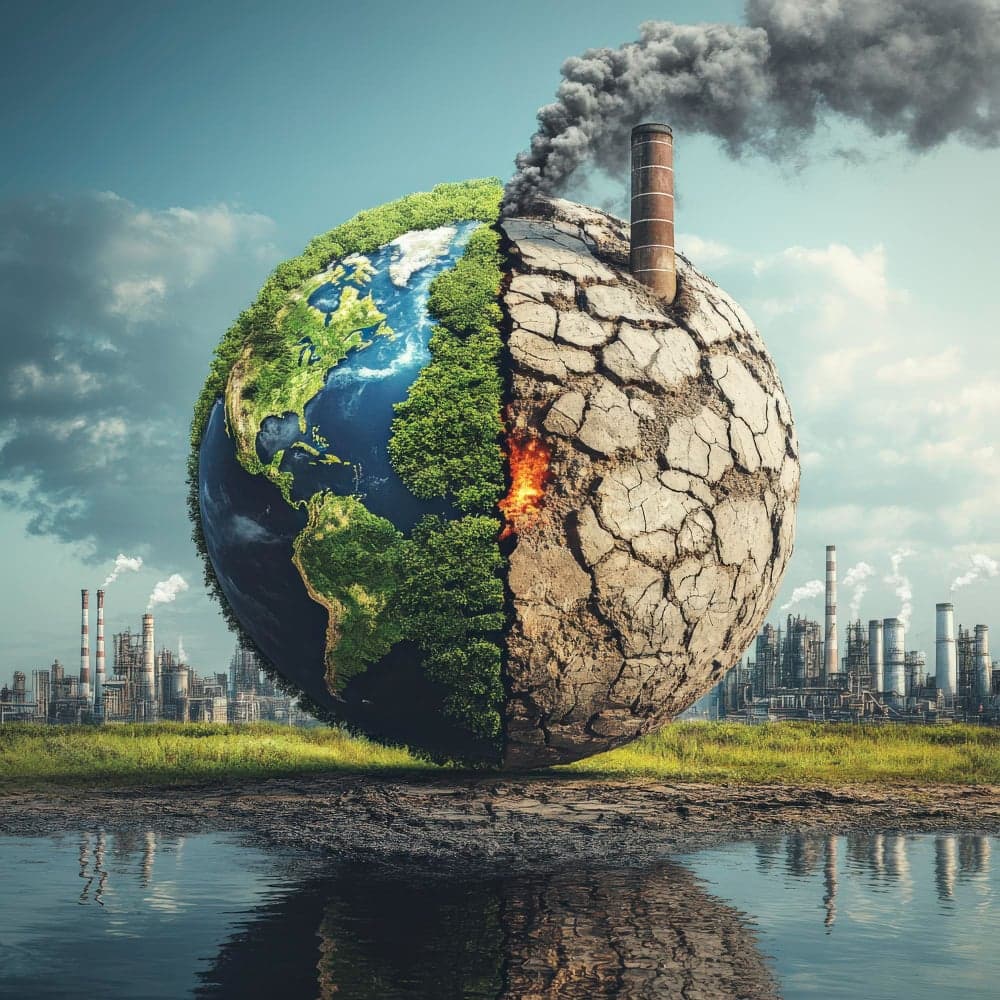
Climate change is no longer a distant concern—it is a reality shaping our environment, economies, and the way we produce food. Agriculture, being directly dependent on weather, soil, and water, is particularly vulnerable. Shifts in temperature, unpredictable rainfall, and more frequent extreme weather events are already affecting farms worldwide. These changes not only threaten the livelihoods of millions of farmers but also put global food security at risk. Understanding the link between climate change and agriculture is essential to finding solutions that can protect our food systems for the future.
How Climate Change Disrupts Farming
One of the most significant impacts of climate change on agriculture comes from rising global temperatures. While some crops in colder regions may initially benefit from warmer conditions, excessive heat can cause plants to mature too quickly, producing smaller yields and lower quality. Heat also places stress on livestock, reducing their fertility, growth rates, and production of milk and meat. In severe cases, prolonged heat waves can lead to animal deaths, directly affecting farmers’ incomes.
Changes in rainfall patterns compound these challenges. In some areas, prolonged droughts leave fields dry and unproductive, while in others, intense rainfall floods crops and erodes soil. For farmers who depend on seasonal rains, these unpredictable shifts can destroy harvests and force changes in planting schedules. Extreme weather events, such as hurricanes, storms, and floods, are becoming more common, wiping out entire harvests in hours and damaging infrastructure critical for storing and transporting food.
Secondary Impacts on Food Systems
The effects of climate change are not limited to direct crop damage. Warmer and wetter conditions allow pests, insects, and plant diseases to spread into new areas. Farmers may be forced to use more pesticides, increasing production costs and risking environmental harm. Soil health also suffers: heavy rains wash away nutrient-rich topsoil, while droughts kill beneficial microorganisms and reduce organic matter, making the land less fertile over time.
Water availability for irrigation is becoming another growing concern. Glaciers are melting, river flows are changing, and rainfall is becoming less predictable. In arid and semi-arid regions, these changes make it increasingly difficult to provide consistent water supplies for crops. For fisheries and aquaculture, changes in water temperature and oxygen levels disrupt breeding patterns, leading to lower yields and threatening coastal food production.
Beyond production losses, climate change also affects food quality. Elevated levels of carbon dioxide can reduce the protein and micronutrient content of staple crops such as rice and wheat. This means that even when calorie levels remain stable, the nutritional value of food declines, potentially worsening malnutrition in vulnerable populations.
Adapting Agriculture to a Changing Climate
While the challenges are severe, solutions exist. Climate-smart agriculture offers an integrated approach, combining practices that increase productivity, strengthen resilience, and reduce environmental impact. This includes growing drought- and heat-tolerant crop varieties, practicing crop rotation, and improving soil health through organic matter restoration and agroforestry.
Efficient water management is critical. Farmers can use drip irrigation, collect rainwater, and recharge groundwater reserves to adapt to water scarcity. Protecting and restoring soils through cover cropping, compost use, and reduced tillage helps improve water retention and resilience against extreme weather.
Technology also plays an important role. Precision agriculture, weather forecasting tools, and early warning systems allow farmers to plan ahead, protect crops, and minimize losses. However, adopting these solutions requires financial support, training, and strong government policies. Subsidies for sustainable practices, investments in agricultural research, and climate risk insurance can help farmers transition to more resilient systems.
Conclusion
Climate change is already reshaping agriculture, threatening both the quantity and quality of food we produce. From rising temperatures and erratic rainfall to the spread of pests and degradation of soil, the risks are complex and interconnected. Yet, with the right combination of innovation, sustainable practices, and policy support, agriculture can adapt and even help reduce the impacts of climate change. The future of food security depends on acting now—building farming systems that are resilient, environmentally responsible, and capable of feeding a growing population in an unpredictable climate.
References
Altered underwater light characteristics impact photoreceptive mesozooplankton and macrozooplankton from physiological responses to community dynamics Ao Shen a,c,1, Fangjie Zhou a,b,c,1, Yawei Jia a,c, Ruobin Wang a,c, Change Liu a,c ,Changqun Duan a,c, Hugh J. Maclsaac d, Torben L. Lauridsen e,f, Ying Pan a,c,*
Hanliang Gui, Qinchuan Xin, Xuewen Zhou, Ying Sun, Yongjian Ruan, Wei Wu, Zhenhua Xiong, Yuhang Tian, Kun Xiao, Developing and evaluating satellite-derived phenology and physiology indicators for modeling annual gross primary productivity variability, Forest Ecosystems, 2025, 100375, ISSN 2197-5620, https://doi.org/10.1016/j.fecs.2025.100375. (https://www.sciencedirect.com/science/article/pii/S2197562025000843) Abstract: Vegetation annual gross primary production (AGPP), the total yearly carbon assimilation via photosynthesis, serves as a key indicator of ecosystem carbon uptake. While AGPP variations are jointly influenced by both vegetation phenology and physiology, the effectiveness of satellite-derived indicators in capturing these variations has not been fully evaluated. This study develops and evaluates the satellite-derived phenology and physiology indicators for modeling AGPP variability. We assessed the performance of satellite-derived metrics, including solar-induced chlorophyll fluorescence (SIF), leaf area index (LAI), and enhanced vegetation index (EVI), in capturing AGPP variations. Among these, SIF-based indicators exhibited the highest accuracy (Pearson’s r = 0.79; root mean square error (RMSE) = 414.7 gC·m−2·year−1), outperforming LAI- and EVI-based indicators. To further investigate the mechanisms driving AGPP variability, we used a structural equation model (SEM) based on in situ observations to quantify the direct and indirect effects of climate on AGPP through phenology and physiology. Our results reveal that vegetation physiology, particularly the seasonal maximum gross primary production (GPP), plays a more dominant role in regulating AGPP than phenology. Furthermore, we found that globally, SIF-derived phenology indicators tend to be lower than those from LAI and EVI, whereas SIF-derived physiology indicators are elevated in tropical regions and the Southern Hemisphere. These findings highlight the potential of satellite-derived indicators in advancing AGPP modeling and emphasize the predominant role of vegetation physiology in regulating ecosystem carbon uptake. This study contributes to a refined understanding of global carbon cycle dynamics and provides insights for improving large-scale carbon assessments in the context of climate change. Keywords: Remote sensing; Vegetation indices (VIs); Vegetation phenology; Vegetation physiology; Carbon sink
Florian Marcel Nuta, The significance of climate policy stringency, environmental taxation, and public debt in addressing climate change challenges, Journal of Environmental Management, Volume 392, 2025, 126924, ISSN 0301-4797, https://doi.org/10.1016/j.jenvman.2025.126924. (https://www.sciencedirect.com/science/article/pii/S0301479725029007) Abstract: This study aims to explore the role of the three types of climate policies (sectoral, cross-sectoral, and international), public debt, and environmental taxation in reducing the greenhouse gases emissions in selected OECD countries between 1995 and 2023. The significance of the study stands in demonstrating the different effects of various instruments in mitigating the climate change. The methodological framework includes fully modified and dynamic OLS models (FMOLS-DOLS) and confirms the robustness of the findings using Driscoll-Kraay estimation regression and Lewbel two-stages least square estimator. In the context of SDG-13, the main results attest the significant influence environmental policy stringency have for mitigating climate change and argues for the usefulness of environmental fiscal instruments. Additionally, the results highlight a marginal effectiveness of public spending for environmental purposes and controls the whole picture by confirming the damaging role of economic growth and urbanization. Furthermore, the research offers novel insights into the environmentally harmful effects of public debt. Based on these original results, the policy recommendations lean towards stricter environmental regulations and carbon fees that can ultimately finance climate actions without affecting public debt, which is also seen as harmful for effectively mitigating environmental issues.


